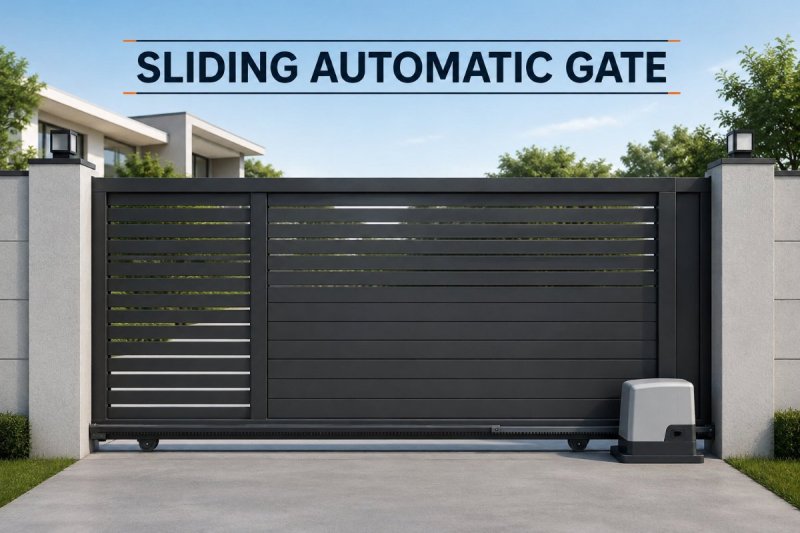
An automatic swing gate is a modern access-control system that combines the traditional appearance of a hinged gate with the convenience of electric automation. Instead of being opened and closed manually, the gate uses electric or hydraulic operators to move one or two gate leaves around vertical hinges.
Automatic swing gates are widely installed at private homes, villas, apartment complexes, office buildings, schools, hotels, healthcare facilities, warehouses, factories, parking areas, and secured commercial properties. They help control vehicle and pedestrian access while improving convenience, security, and the overall appearance of an entrance.
A properly designed automatic swing gate can be operated through remote controls, digital keypads, RFID cards, smartphone applications, video intercoms, biometric readers, vehicle loop detectors, and license-plate recognition systems. It can also be integrated with security cameras, alarms, smart-home systems, and building-management platforms.
However, reliable automation depends on much more than simply attaching a motor to an existing gate. The gate’s weight, width, construction material, hinge condition, opening angle, post dimensions, wind exposure, daily operating frequency, and safety requirements must all be evaluated.
This comprehensive guide explains how automatic swing gates work, their main components, operator types, advantages, limitations, installation process, safety features, maintenance requirements, common problems, cost factors, and key considerations when choosing a system.
What Is an Automatic Swing Gate?
An automatic swing gate is a motorized entrance gate that rotates inward or outward around a hinge point. Its movement is similar to a conventional door, but the gate is controlled by an automation system rather than being pushed by hand.
Swing gates are generally available in two configurations:
-
Single-leaf swing gates
-
Double-leaf swing gates
A single-leaf gate uses one large panel that covers the complete entrance. It may be suitable for smaller openings or properties where the design requires a single uninterrupted gate.
A double-leaf gate uses two panels that meet in the center. Each panel opens in the opposite direction. This configuration is popular for wide entrances because it creates an attractive, balanced, and symmetrical appearance.
Automatic swing gates can be manufactured from several materials, including:
-
Steel
-
Galvanized steel
-
Aluminum
-
Stainless steel
-
Wrought iron
-
Timber
-
Composite panels
-
Perforated metal
-
Decorative metal sections
-
Combinations of metal, glass, and wood
The material and design influence the gate’s weight, strength, maintenance requirements, wind resistance, and required motor capacity.
A lightweight open-bar aluminum gate normally requires less operating force than a large solid steel or timber gate. Solid gates provide better privacy, but they can create considerable wind resistance. In strong winds, a solid gate leaf can behave like a sail and place significant pressure on the operator, hinges, brackets, posts, and electric lock.
How Does an Automatic Swing Gate Work?
An automatic swing gate operates through a combination of mechanical components, electrical power, electronic controls, and safety devices.
When a user activates an approved access-control device, a signal is sent to the gate control panel. The control panel processes the command and activates the motors. The operators then push or pull the gate leaves until they reach the programmed open position.
After the vehicle or pedestrian passes, the gate can close automatically after a preset delay or after receiving a separate closing command.
A standard operating cycle usually includes the following stages:
-
The user presses a remote-control button, enters a code, presents an access card, or activates a mobile application.
-
The access-control device sends a command to the control board.
-
The control board verifies and processes the signal.
-
The electric lock releases, if one is installed.
-
The gate operators begin moving.
-
The gate leaves rotate around their hinges.
-
Safety devices monitor the opening area.
-
The gates reach the programmed open position.
-
The system waits for a preset period or a closing command.
-
The photocells confirm that the entrance is clear.
-
The gates close in the programmed sequence.
-
The electric lock secures the gate.
Modern swing gate systems often include soft-start and soft-stop functions. The gates begin moving gradually, operate at normal speed, and slow down before reaching their final positions. This controlled movement reduces impact, noise, vibration, and mechanical stress.
Double-leaf gates may also use a leaf-delay function. One gate leaf opens slightly before the other and closes slightly after it. This is necessary when the two leaves overlap, use a center stop, or depend on a shared electric lock.
Main Components of an Automatic Swing Gate
A reliable automatic swing gate consists of several interconnected components. The performance of the complete system depends on the correct selection, installation, and adjustment of every component.
Gate Leaves
The gate leaves create the physical barrier across the entrance.
Their important characteristics include:
-
Width
-
Height
-
Weight
-
Material
-
Frame strength
-
Wind resistance
-
Decorative design
-
Opening direction
The gate structure must be strong enough to support automation. A weak, bent, or flexible gate can vibrate, twist, or become misaligned during operation.
Hinges
The hinges support the gate leaves and allow them to rotate.
Before automation is installed, each gate leaf should move smoothly by hand. Excessive resistance may indicate:
-
Corroded hinges
-
Poor alignment
-
Bent posts
-
Damaged bearings
-
Incorrect hinge spacing
-
Structural deformation
A motor should never be used to force a gate with defective hinges. Doing so increases energy consumption, reduces motor life, and may create unsafe movement.
Gate Operators
The gate operators provide the mechanical force needed to open and close the leaves.
Common operator types include:
The correct operator depends on gate size, weight, hinge position, post geometry, opening angle, daily usage, and required appearance.
Control Panel
The control panel is the electronic center of the system.
It controls functions such as:
-
Opening direction
-
Closing direction
-
Motor speed
-
Acceleration
-
Deceleration
-
Opening angle
-
Automatic closing delay
-
Pedestrian access
-
Motor synchronization
-
Force limits
-
Safety devices
-
Electric locks
-
Warning lights
-
Battery backup
-
Remote controls
Some operators include an integrated control board, while more advanced systems use a separate weather-resistant enclosure.
Photocells
Photocells create an invisible beam across the gate entrance.
If a person, vehicle, animal, or object interrupts the beam, the gate should stop or reverse. Photocells are essential because they reduce the risk of a closing gate striking an obstacle.
Safety Edges
Safety edges are pressure-sensitive devices installed on potential impact or crushing zones.
When a safety edge touches an object, it sends a signal to the control panel. The gate then stops or reverses.
Electric Lock
An electric lock secures the gate leaves in the closed position.
It is especially useful for:
-
Wide gates
-
Heavy gates
-
Double-leaf gates
-
Wind-exposed entrances
-
High-security locations
The control panel releases the lock before activating the motors.
Gate Stops
Mechanical gate stops define the fully open and fully closed positions.
They help prevent excessive motor movement and reduce unnecessary stress on the operators.
Access-Control Devices
Automatic gates can be controlled by several devices, including:
Warning Light
A flashing warning light informs nearby users that the gate is moving.
This feature is particularly valuable in shared residential, commercial, school, hospital, and industrial environments.
Backup Battery
A backup battery allows the gate to operate during a temporary power outage.
Without backup power, users must activate the manual-release mechanism and move the gate by hand.
Types of Automatic Swing Gate Operators
Choosing the correct operator is one of the most important parts of swing gate design.
| Operator Type |
Best Application |
Main Advantages |
Important Considerations |
| Linear-arm operator |
Residential and light commercial gates |
Compact, affordable, reliable, easy to maintain |
Requires suitable hinge and post geometry |
| Articulated-arm operator |
Gates mounted on large masonry pillars |
Flexible installation and smooth operation |
More visible than linear or underground systems |
| Underground operator |
Luxury homes, hotels, and architectural projects |
Hidden mechanism and clean appearance |
Requires excavation, waterproofing, and drainage |
| Hydraulic operator |
Heavy gates and high-traffic entrances |
Powerful, smooth, and durable |
Higher cost and professional maintenance requirements |
| Wheel-drive operator |
Special, wide, or unusual gate designs |
Useful when standard arms are unsuitable |
Requires a smooth and stable ground surface |
Linear-Arm Operators
Linear-arm operators use a straight actuator that extends or retracts to move the gate.
They are among the most common options for residential properties because they are compact, relatively economical, and suitable for many steel and aluminum gates.
However, correct installation geometry is essential. The relationship between the hinge point, gate post, mounting bracket, and operator length determines the available opening angle and mechanical force.
Incorrect geometry can cause:
Articulated-Arm Operators
Articulated-arm operators use a jointed arm similar to a human elbow.
They are ideal for gates mounted on wide masonry, stone, or brick pillars. The flexible arm can reach around the pillar and move the gate even when the hinge is positioned far from the mounting surface.
These systems are generally easy to service and provide smooth movement. However, the arm is more visible and requires sufficient clearance behind the gate.
Underground Operators
Underground operators are installed beneath the gate hinge in a specially designed foundation box.
They are frequently selected for luxury homes, historic properties, hotels, and architecturally sensitive projects because most of the mechanism remains hidden.
The main advantages include:
The main challenge is drainage. Water must not accumulate inside the foundation box. Poor drainage can cause corrosion, electrical failure, and mechanical damage.
Hydraulic Operators
Hydraulic operators use pressurized fluid to move the gate.
They are designed for demanding installations involving:
Hydraulic systems usually provide powerful, smooth, and quiet movement. Their initial cost may be higher, but they can offer excellent durability when correctly installed and maintained.
Main Advantages of an Automatic Swing Gate
Improved Property Security
An automatic gate creates a controlled boundary between a property and the public area.
It can restrict unauthorized vehicle access and support a complete security system that includes:
A closed gate also acts as a visible deterrent.
Greater Convenience
Users do not need to leave their vehicles to open or close the gate.
This is particularly useful during:
-
Rain
-
Snow
-
Strong wind
-
Extreme heat
-
Nighttime
-
Heavy traffic
Automatic operation is also helpful for elderly people, individuals with limited mobility, property staff, delivery drivers, and frequent users.
Attractive Appearance
Swing gates are popular because of their elegant and traditional movement.
They can be designed in:
A double-leaf swing gate can create an impressive symmetrical entrance.
Controlled Access
Property owners can determine who is allowed to enter and when.
Temporary codes can be issued to guests, contractors, maintenance staff, and delivery drivers. Lost access cards can be disabled, and commercial systems can keep detailed entry records.
A specialist supplier such as hasongate may provide automatic swing gate systems with different motors, access-control devices, and safety accessories for residential and commercial projects.
Smart-System Integration
Modern gates can connect to:
-
Smartphone applications
-
Home-automation platforms
-
Security cameras
-
Building-management software
-
Cloud-based access systems
-
Voice-control devices
-
Alarm systems
Users may be able to check the gate position, open the entrance remotely, receive notifications, or provide temporary visitor access.
Increased Property Value
A professionally installed automatic gate can improve the property’s appearance, security, convenience, and perceived quality.
These factors may increase buyer interest and contribute to a stronger first impression.
Potential Disadvantages
Opening Space Requirements
A swing gate requires a clear movement area.
Vehicles, walls, steps, trees, landscaping, storage items, and other obstacles must remain outside the opening arc.
This may make swing gates unsuitable for short driveways.
Sloping Driveways
If the driveway rises in the opening direction, the bottom of the gate may strike the ground.
Special rising hinges can sometimes solve this problem, but they increase mechanical complexity. A sliding gate may be more suitable for steep entrances.
Wind Load
Large solid gate leaves can experience strong wind pressure.
Wind can overload:
-
Motors
-
Hinges
-
Mounting brackets
-
Gate posts
-
Locks
-
Foundations
Open-bar or perforated designs may be preferable in exposed locations.
Professional Installation Requirements
Incorrect installation can lead to:
A professional site assessment is strongly recommended.
Maintenance Needs
Automatic gates contain moving mechanical parts, electronic components, cables, sensors, and control devices.
These components require periodic inspection and servicing.
Automatic Swing Gate Versus Automatic Sliding Gate
| Feature |
Automatic Swing Gate |
Automatic Sliding Gate |
| Movement |
Rotates inward or outward |
Moves horizontally |
| Required space |
Clear space in front of or behind the gate |
Clear space beside the entrance |
| Appearance |
Traditional, elegant, and symmetrical |
Modern, compact, and practical |
| Short driveway |
May be unsuitable |
Usually suitable |
| Sloping entrance |
Can be difficult |
Generally more suitable |
| Ground track |
Usually not required |
Required for tracked systems |
| Side space |
Limited side space required |
Significant side space required |
| Wind sensitivity |
High for large solid leaves |
Usually more stable when guided |
| Main maintenance areas |
Hinges, arms, locks, and brackets |
Track, wheels, rack, and guide rollers |
| Typical use |
Homes, villas, hotels, formal entrances |
Parking areas, factories, short driveways |
Important Factors to Consider Before Buying
Gate Weight and Width
Every operator has a maximum gate-leaf weight and width.
These limits should not be considered independently. A wide lightweight gate may still create high mechanical stress because of leverage and wind load.
A suitable motor safety margin is advisable.
Gate Material
Steel gates may be strong but heavy. Aluminum gates are lighter and more corrosion-resistant. Timber gates may change weight as they absorb moisture.
The material affects motor sizing and maintenance requirements.
Daily Operating Cycles
A private home may use the gate only a few times per day.
An apartment building, school, office, hotel, or factory may require dozens or hundreds of cycles. The operator’s duty cycle must match the expected use.
Opening Angle
Most swing gates open approximately 90 degrees, but some installations require wider opening angles.
The required angle affects operator type, mounting geometry, and available space.
Post Dimensions
The shape and depth of the gate posts are extremely important.
Narrow metal posts may support linear operators, while large masonry pillars may require articulated-arm or underground systems.
Wind Exposure
Wind conditions should be assessed before selecting the gate design and motor.
Large solid panels may require stronger operators, reinforced posts, electric locks, and reduced opening speeds.
Environmental Conditions
The system should be suitable for local exposure to:
-
Rain
-
Dust
-
Snow
-
Ice
-
High temperatures
-
Freezing temperatures
-
Humidity
-
Coastal salt
-
Industrial pollution
Corrosion-resistant coatings, sealed enclosures, and suitable protection ratings may be necessary.
Power Supply
The installation requires a safe and stable electrical connection.
Cables should be installed in protective conduits and protected from water, physical damage, and unauthorized access.
The system may also require:
-
Circuit protection
-
Surge protection
-
Battery backup
-
Solar charging
-
Emergency power
Access-Control Requirements
A small home may only need remote controls and a video intercom.
A commercial building may require:
-
Employee cards
-
Visitor codes
-
Entry records
-
Time-based access permissions
-
Biometric identification
-
License-plate recognition
-
Central management software
Installation Process
Professional installation normally begins with a detailed site survey.
The installer should evaluate:
A typical installation process includes:
-
Inspecting the existing gate structure.
-
Repairing or replacing defective hinges.
-
Confirming smooth manual movement.
-
Selecting the appropriate operator.
-
Installing mounting brackets.
-
Mounting the operators.
-
Installing the control panel.
-
Running protected electrical cables.
-
Installing photocells and safety edges.
-
Installing gate stops and an electric lock.
-
Connecting access-control devices.
-
Programming opening and closing limits.
-
Adjusting speed and force.
-
Programming leaf delay.
-
Testing automatic closing.
-
Testing obstacle detection.
-
Testing the manual-release mechanism.
-
Training the property owner or manager.
The gate must move freely before automation is connected. A motor should not be used to compensate for poor hinges, bent posts, or a damaged structure.
When comparing equipment offered by providers such as hasongate, buyers should confirm that the selected motor is suitable for the gate’s actual width, weight, wind exposure, and operating frequency.
Essential Safety Features
Automatic gates are large moving machines, so safety must be treated as a fundamental design requirement.
Photocells
Photocells prevent the gate from closing while the entrance is occupied.
They should be cleaned, aligned, and tested regularly.
Safety Edges
Safety edges detect physical contact with an obstacle.
They can be installed on:
-
Leading gate edges
-
Hinge areas
-
Gate posts
-
Crushing zones
-
Closing zones
Obstacle Detection
Modern operators can monitor motor current, torque, or movement resistance.
If unexpected resistance is detected, the system stops or reverses. This feature should support, not replace, physical safety sensors.
Vehicle Loop Detectors
Inductive loops installed beneath the driveway detect vehicles.
They can:
Manual Release
The manual release disconnects the operator during a power failure or equipment fault.
Users should know how to operate it safely before an emergency occurs.
Warning Light
A flashing light alerts nearby people when the gate is moving.
An audible warning may also be appropriate in industrial, school, or high-traffic environments.
Emergency Stop
Commercial installations may include an emergency-stop button that immediately stops the gate.
Maintenance of an Automatic Swing Gate
Regular maintenance improves reliability, safety, and service life.
Recommended maintenance tasks include:
-
Cleaning photocell lenses
-
Checking hinge alignment
-
Inspecting mounting brackets
-
Tightening loose bolts
-
Testing safety reversal
-
Testing safety edges
-
Checking the electric lock
-
Inspecting gate stops
-
Testing the manual release
-
Checking motor cables
-
Inspecting the control enclosure
-
Testing remote controls
-
Testing warning lights
-
Checking backup batteries
-
Inspecting corrosion
-
Removing debris from the gate area
-
Listening for unusual noise
-
Checking for water in underground operator boxes
Lubrication should only be applied to approved points and according to the manufacturer’s instructions.
Excessive grease can attract dust and create additional wear.
Commercial and industrial gates require more frequent servicing because they operate more often.
Common Problems and Troubleshooting
The Gate Does Not Open
Possible causes include:
The Gate Opens but Does Not Close
Possible causes include:
The Gate Moves Slowly
Possible causes include:
-
Worn hinges
-
Low voltage
-
Excessive wind
-
Incorrect force settings
-
Mechanical obstruction
-
Motor wear
-
Cold weather
One Gate Leaf Does Not Move
In a double-leaf system, the problem may involve:
The Gate Reverses Unexpectedly
The system may be detecting excessive resistance, a blocked sensor, or an incorrectly adjusted safety device.
The Electric Lock Does Not Engage
The lock may be:
Electrical repairs should be completed by qualified technicians.
Cost Factors
The total cost of an automatic swing gate depends on:
-
Gate material
-
Entrance width
-
Gate height
-
Number of leaves
-
Gate weight
-
Decorative design
-
Operator type
-
Motor capacity
-
Post construction
-
Safety equipment
-
Electric locks
-
Access-control devices
-
Intercom systems
-
Battery backup
-
Camera integration
-
Electrical work
-
Foundation work
-
Installation complexity
-
Maintenance support
Linear-arm systems are generally more affordable than underground or hydraulic systems.
However, the cheapest system is not always the most economical. An undersized motor, poor installation, or missing safety equipment can create expensive repairs and reliability problems.
Residential Applications
Automatic swing gates are frequently installed at:
-
Private houses
-
Villas
-
Apartment buildings
-
Gated communities
-
Holiday homes
-
Shared driveways
Residential users often prioritize:
-
Quiet movement
-
Attractive appearance
-
Remote controls
-
Smartphone access
-
Video intercoms
-
Pedestrian opening
-
Privacy
Commercial and Industrial Applications
Swing gates can also be used at:
-
Offices
-
Hotels
-
Schools
-
Hospitals
-
Warehouses
-
Factories
-
Parking areas
-
Government facilities
-
Storage compounds
These installations may require heavy-duty operators, high duty cycles, access logs, security cameras, vehicle loops, and emergency systems.
hasongate may be considered when comparing automatic swing gate products for projects that require reliable automation, professional access control, and compatibility with modern security systems.
Smart Automatic Swing Gate Technology
Smart technology allows users to control and monitor gates remotely.
Depending on the system, users may be able to:
-
Open the gate through a smartphone
-
Check whether the gate is open or closed
-
Create temporary visitor access
-
Receive movement notifications
-
Review entry records
-
Connect the gate to CCTV cameras
-
Disable lost cards
-
Schedule opening times
-
Manage multiple entrances
-
Integrate the gate with alarms
Cybersecurity is also important. Smart gate systems should use strong passwords, secure communication, limited user permissions, and regular software updates.
Choosing a Reliable Supplier and Installer
A professional provider should evaluate the complete entrance rather than only recommending a motor.
The service should include:
Before purchasing a system, property owners should request:
-
Technical product specifications
-
Motor capacity information
-
Safety-device details
-
Warranty conditions
-
Installation references
-
Maintenance instructions
-
Emergency-support information
A reliable installer should clearly explain why a particular operator and safety configuration are suitable for the property.
Conclusion
An automatic swing gate is an effective solution for improving security, convenience, access control, and architectural appearance. It combines the familiar movement of a traditional hinged gate with electric automation and modern electronic technology.
The gate can be operated through remote controls, keypads, access cards, intercoms, smartphone applications, biometric readers, vehicle detectors, and license-plate recognition systems. It can also be integrated with security cameras, alarms, smart-home systems, and building-management platforms.
Reliable performance depends on careful planning. Gate width, weight, material, hinge condition, post geometry, wind exposure, opening angle, daily usage, and environmental conditions must all be evaluated.
Safety devices such as photocells, safety edges, obstacle detection, warning lights, vehicle loops, manual-release systems, and emergency stops are essential. Regular inspection and professional maintenance are equally important.
When correctly designed, professionally installed, and properly maintained, an automatic swing gate can provide secure and convenient access for many years. It is a suitable option for private homes, villas, apartment complexes, hotels, offices, schools, commercial buildings, and industrial properties that require reliable entrance automation.
:: بازدید از این مطلب : 37
|
امتیاز مطلب : 0
|
تعداد امتیازدهندگان : 0
|
مجموع امتیاز : 0


 عضو شوید
 عضویت سریع
 آمار مطالب
 آمار بازدید